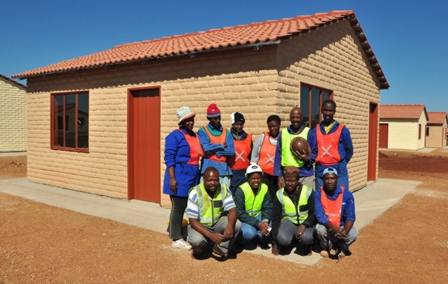
 Diamond-Maxi concrete bricks, concrete roof tiles and bevelled concrete pavers are being used in the fully government subsidised housing development in Ga-Rankuwa Extension 24.
Funded by the Gauteng Department of Local Government and Housing (Tshwane Region) and situated in the North West Province, this is a cross-border project which entails the construction of 1 516 houses for the Tshwane Metropolitan Municipality.
The 40m² houses comprise two bedrooms, a combined kitchen and living area, and a room containing a shower and toilet. As yet there is no electricity supply to the development although this is planned for the future, as is the installation of solar water heating for the houses.
Commenting on the project, director of the Concrete Manufacturers Association (CMA), Hamish Laing, says that properly selected and put to use precast concrete building materials form an extremely effective combination, especially for the construction of housing.
“The concrete bricks being used on this project have an attractive diamond-face finish which means that the walls don’t require plastering, only painting, and the inner walls are bag-washed – both processes that save costs,” Laing points out.
The Diamond Maxi concrete bricks, measuring 140 by 90 by 290mm, are being supplied by Delta Bricks and Eckraal Quarries and are used in a single-skin application. The roof tiles are being manufactured by West End Claybrick and Coverland. They are being laid on galvanised steel trusses supplied by Vela Steel Building Systems. The paving blocks, 50mm thick and rated at 25MPa, are being produced by Technicrete.
Laing says that concrete pavers are preferable to cast in-situ concrete for the paved surrounds due to their greater durability and visual appeal.
He also highlights that precast concrete products – as used in this project – promote labour-intensive construction and support job creation locally, with the labour cost component of the housing units amounting to about 20.5% of the total cost of construction.
Construction work began on this Ga-Rankuwa development in January, under the control of the main contractor, Jade Africa Developments. The subcontractors appointed to the project have recruited about 70% of their work teams locally. The project is being built in three phases and is scheduled for completion in the first quarter of 2012.