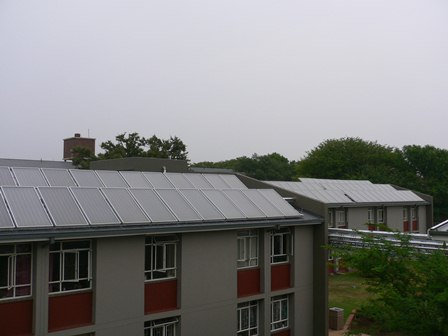
 Holms and Friends, formerly Omnibus Engineering and a member of SESSA, the Sustainable Energy Society of Southern Africa, has installed a solar water heating system at the University of Pretoria’s Onderstepoort campus. With a total collector surface of 672m2 this is the biggest glazed installation in Southern Africa.
The installation meets the warm water needs of the university’s new energy-efficient residences which house 550 students. It also prevents the output of 450 tons CO2 and saves 600 980 litres of water per year.
Alec Blackhall, manager of residence affairs and accommodation at UP, says, “The system is fully functional and the savings are remarkable.”
Omnibus Engineering, which recently changed its name to Holms and Friends, was established in 2003. The company specialises in integrated energy strategies, project design and management for large-scale, commercial solar water heating and photovoltaic systems. It also provides training in the renewable energy and energy efficiency sector as well as education for sustainable development.
Onderstepoort, home to South Africa’s only veterinary faculty, is in Pretoria North. This geographical area falls within the Northern Middleveldt, a climatic region characterised by distinct rainy and dry seasons, a large diurnal temperature range and strong solar radiation.
This led Holms and Friends to specify Sunda PG2.0-F/G flat plate collectors instead of the costlier but more efficient vacuum-tube collectors. Some 336 collectors, each two square metres in area, were installed on the roofs of the campus carports and other buildings. The installation connects three collectors in parallel and then two parallel ‘strings’ in series, resulting in a thermal length of 12m. The total capacity of the installation – 430kWh – could produce 404 700kWh of electricity a year.
One central feeder tube transports the warm water to a building that was constructed next to the carport to house the heart of the system: two giant 20 000-litre water storage tanks, an expansion tank, membrane expansion vessels (totalling 5 400 litres) and seven external heat exchangers, among other elements.
The water heated by the solar panels is stored in the buffer tanks. Through external heat exchangers (that is, exchangers not housed in the tanks themselves), a separate continuous freshwater supply is warmed and distributed to the individual residences.
This is an indirect loop system which automatically complies with health standards and avoids the need to manage a major maintenance programme as the solar heated water in the buffer tanks will not be used for human consumption. It is, simply, the ‘working fluid’ of the system.
The water is pumped through heavily insulated 40mm-diameter distribution pipes, mounted on steel frame structures, to reach each residence on campus.
Normal grid-connected electric heating serves as a back-up for the system but, in the six months since it went live, this has not been needed.