 In the paving industry SEPT stands for small element paving technology. The SEPT Association is an international organisation that promotes research and development in concrete block paving (CBP). Drawing its members from academia and representative organisations in the industry from around the world, it stages global conferences triennially and interim steering committee workshops are held every 18 months.
This year’s SEPT planning workshop, held in Dresden, Germany, in May, was attended by two representatives from South Africa’s Concrete Manufacturers Association (CMA): director, Hamish Laing, and former director and paving consultant, John Cairns.
Laing presented the gathering with an update on CBP trends in South Africa. He covered the progress made on permeable paving and shared the CMA’s successes in promoting CBP as an appropriate road surface for low-trafficked urban roads, especially in the upgrading of existing township roads. Laing also covered the CMA-sponsored research into the discolouration of certain types of concrete paving blocks.
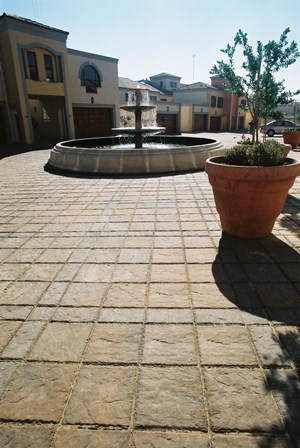
Other presentations at the workshop highlighted a number of new developments. Laing reports that one of the new trends emerging is the growing demand for larger paving blocks, some of them up to a square metre in size.
“They are being used for aesthetic purposes in public, pedestrian areas such as malls, squares, pavements and paths. Many of the malls in Dresden, which is one of Germany’s most beautiful cities, have been paved with concrete flagstones.”
Cairns notes that concrete flagstones are manufactured in South Africa although production is relatively limited as the smaller concrete paving blocks are much more widely used. One of the factors influencing this common preference for smaller paving blocks is that the bigger flagstones are restricted to applications in pedestrian-only zones. “Concrete flagstones are not suitable for roadways or thoroughfares that are required to serve vehicular traffic, so the smaller concrete paving blocks are more versatile,” Cairns comments.
Another interesting CBP development that Laing highlights is the incorporation of granulated rubber into paving blocks as a sound-dampening material. While this is not something likely to be taken up locally, other than in once-off purpose-specific applications, Laing says, “Noise pollution is taken very seriously in countries like Germany. High density urban living makes noise pollution a much more pressing concern, to the extent that noise-dampening technology is also now being used in masonry construction.”
Germany is the world’s leading manufacturer of CBP, producing over 100 million square metres annually. The USA is the second largest producer with an output of some 50 million square metres a year, most of it for the domestic market. South Africa produces around 12 million square metres annually for the industrial, commercial and residential markets. Most other SEPT member countries produce between 10 and 20 million square metres a year.
Laing observes that German companies manufacture CBP units in thicknesses ranging from 80mm up to 120mm and don’t make anything thinner than 80mm. By contrast, South African manufacturers produce blocks from 50mm thick and blocks of 80mm thickness are at the top end of the scale, with blocks of 100mm thickness being used only rarely.
Cairns adds that in Germany, which is considered “the inventor” of concrete block paving, standards are particularly high. “The advantage of the thicker paving blocks is that they carry a greater share of loading so less stress is transferred to the base and sub-base of paving installations – which, in South Africa, is where problems usually occur. The blocks of greater thickness generally make for a long-term maintenance-free installation, as required by German standards for CBP.
“In Germany, standards stipulate that blocks thinner than 80mm can be used only in areas where vehicular access is physically impossible whereas in the South African market we have become accustomed to using the 50mm blocks for pedestrian areas and 80mm blocks for heavier traffic – and dealing with maintenance and reinstatement issues if they do arise.”
None the less, Cairns reports that 50mm to 80mm blocks are typical in most CBP producing countries and he notes that in the CBP industry, South Africa is seen as a first world player – generally highly regarded for its product research, development and innovation.
For example, the CMA is involved with other SEPT members in ongoing research to determine the ideal base materials for permeable paving installations. The project is being conducted at Australia’s New South Wales University under Dr Brian Shackel and the major funder is the Australian Research Council. The CMA is one of the other funders which also include: Australia’s CMAA, Interpave UK, Dresden University, the Belgian Road Research Centre and Uni-Group USA.
Cairns says that the research is still at a relatively early stage but the aim is to find the optimum mix of base materials which will deliver the required balance of structural strength and permeability. “To date, permeable paving installations have been based on what is considered the best mix of materials. While most of the existing installations in South Africa are performing well, in some cases the mistake has been made of using common bedding and jointing sand instead of a more open, permeable matrix that allows for rain or storm-water to dissipate freely.
“The current research is testing various options scientifically and will provide us with demonstrated evidence of the best material mix. This will support best practice and the more widespread use of permeable paving in South Africa and internationally,” he says.
Other participants in the SEPT Dresden workshop included CBP experts from Argentina, Australia, Belgium, Brazil, Canada, China, Germany, Israel, the UK and the USA. Each reported on developments in their home country.
The next SEPT Conference and Exhibition will be held in 2012 in Shanghai from 25 to 27 November, to coincide with China’s 2012 construction and building materials and machinery exhibition, Bauma, which will take place from 27 to 30 November. The next SEPT workshop will be held in Cape Town in 2014 and the 2015 conference will be held in Dresden.