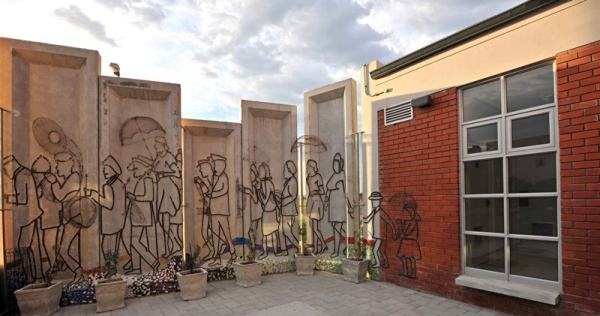
 The City of Cape Town’s Human Settlements Contact Centre in Manenberg has recently been awarded a 4-star Green Star SA rating. It is the first newly built municipal building in South Africa to achieve a Green Star SA rating.
Designed by Ashley Hemraj, an architect with the City of Cape Town, and with Goodhope Construction as the main contractor, the building is on Landsdowne Road in Manenberg. It serves as a contact point where the local community can make enquiries on the housing database and housing developments and pay their municipal accounts. It was completed in April 2012 and was awarded its Green Star rating in August.
Embarking on the project Hemraj had no guidelines on what was required to obtain a Green Star rating for a municipal building and used information available from various sources. The results are a demonstration of the Cape Town municipality’s commitment to sustainable development and its green goals.
Hemraj says that as well as the concerns for environmental responsibility, the selection of the site, the position of the building and the involvement of the local community were of great importance.
Local artists and members of the local community were involved in producing the mosaic work throughout the building, other artworks and the graffiti works.
“We involved the self-taught Cape Town-based graffiti artist Falko, who is doing his best to get the youth off the street and involved in art that could inspire and change lives,” Hemraj says. He explains that Falko, born in Mitchells Plain and schooled locally, engaged three local schools where he trained 10 Grade 5 and 6 pupils in the art form – at the same time creating the artwork for the Manenberg project.
Hemraj adds that involving the local community is a way of making community buildings that relate to the people they serve and of inviting the community to take ownership of their building.
Local workers were also trained on-site to build the sandbag walls – filling, laying and then plastering the bags – as well as in the assembly of the ‘Eco Beams’. According to Hemraj, people employed from the local community accounted for 20% of the labour on-site, when it is typically less than 10%.
Different materials were used in construction of the building, including the sandbag technology, FSC-certified timber, recycled steel, and clay face bricks, chosen for their ecologically efficient properties. “We selected the Corobrik De Hoop Satin brick which is made nearby at the De Hoop factory, another advantage when aiming for a Green Star rating,” says Hemraj.
“It’s important that our public buildings become landmarks, beacons in their communities. It’s important that they have a civic presence, a stature that speaks of the community and reflects their past, present and individuality. In this case, the red brick identifies the municipal building in an aesthetically pleasing and contemporary way as well as being environmentally responsible.
“We are hoping that further buildings in the civic precinct will follow suit with locally sourced materials.”
The building also includes specific water- and energy-saving systems making use of rainwater harvesting and its own on-site black-water treatment system as well as solar panels and a wind turbine which reduce consumption of electricity supplied by the municipality.
However, Hemraj emphasises the socio-economic aspects of the project. “Although we didn’t get any points for our primary objective to include unskilled local labour and provide on-site training, these are starting to become an important element of green buildings.
“We want the community to be proud of where they live, so that they feel comfortable to reinvest in and remain committed to fighting for a better community environment. We wanted this building to be an inspiration in Manenberg, something that we the City and the community can be proud of.”