Stefan van Biljon, a graduate of the School of Architecture at the University of Cape Town, is the winner of the Corobrik Architectural Student of the Year Award for 2010. This announcement was made on 30 March at a function hosted by Corobrik at The Wanderers Club in Johannesburg. With all the finalists present except van Biljon – who is currently working at the offices of Renzo Piano in Milan – Corobrik set up a Skype link so that he could be a part of the event and could hear the news live.
Taken quite by surprise, van Biljon thanked Corobrik for the opportunity that the annual student competition presents and for the generous cash prize he received. He also thanked his lecturers at UCT for all their encouragement to him in working through his final year thesis, and he thanked his friend Renee, for setting up his work in the regional finalists’ exhibition. (A separate Skype crossing had enabled the jurors to interview van Biljon directly about his project during the judging process.) At the evening function, Renee accepted the award on van Biljon’s behalf.
As in previous years a prominent theme of the 2010 competition was sustainability. Dirk Meyer, managing director of Corobrik, highlighted how the annual awards programme fits well with the organisation’s commitment to driving for sustainable outcomes in all aspects of its business and the respected role that clay bricks play throughout South Africa and abroad in providing enduring value in the built environment with low impacts on the natural environment.
Building on the theme of sustainability, Henning Rasmuss of Paragon Architects presented the keynote address, entitled The Big Five: Building with Attitude. Rasmuss put forward five big ideas that he considers important in establishing integrity in the process of creating sustainable architecture.
The judging panel this year included: Fanuel Motsepe of Motsepe Architects and president of the South African Institute of Architects, Sarah Calburn of Sarah Calburn Architects, Dean Jay of Jay Nel Architects, and Peter Kidger of Corobrik as the convenor.
Once the regional finalists have set up their projects, complete with scale models, at The Wanderers venue, the judging process gets under way. Each finalist has the opportunity to present their thesis and discuss it with the panel of judges in an hour-long interview. Each project is assessed against a number of criteria, including its groundedness in a world view, its technical merits and its long-term sustainability.
Speaking on behalf of the judging panel, Sarah Calburn noted “the incredibly wide range of concerns underpinning the work of every student… It is precisely this richness, this complexity, this degree of complication and simultaneous thought that makes architecture so difficult, and so endlessly interesting. It is precisely this rare combination that we, as jurors, have had to negotiate in coming to a final decision on the winning project.”
None the less, she said the judges were unanimous in their final decision.
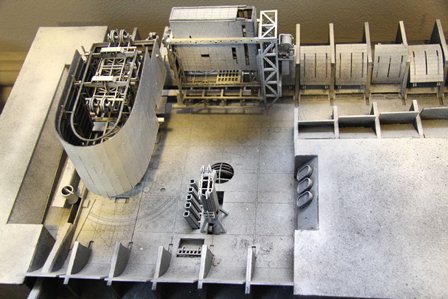
KL-Metamatic: Ghost Ship
Van Biljon’s thesis project, entitled KL-Metamatic: Ghost Ship and located at KL Berth in Cape Town’s Duncan Dock, he describes as “inspired by the tension between an abandoned industrial site and natural forces.
“A seawall manifold reintroduces water to the reclaimed site. The tide is choreographed to create a changing landscape that registers the passage of time as the sea gradually consumes the site. The effects of the flood are used to amplify the atmosphere. The flood machine communicates in gesture, compelling guests to interpret its response to the elements. Atmospheric restlessness is used to creat a place of contemplation.
“Facing systematic destruction, the building haunts KL-Berth and the site becomes a barometer for wider environmental issues.”
Judges’ comments
The judges selected this project as the national award-winning project because of the level of intellect demonstrated and the way van Biljon had thought through the concept.
In their critique the judges noted, among other things: “The KL Berth in Duncan Dock, Cape Town, is an isolated post-industrial inner city relic (of sorts) that holds a strong childhood visual memory for the author of this thesis…
“Although this is a project without direct ‘function’ as we know it, its author nevertheless manages to make direct and useful links to wider global currencies – in this case, the effects of global warming and associated rise of sea levels. The building is timed to erode, the site is timed to flood and flood again, parts of its envelope are machined to move with the tides, its experience is calibrated simply by the silent personal journey. All parts of the building are alive to every human sense: sounds, textures, secrets, memories, sight and tastes are shaped, blinded or amplified through a sophisticated palette of industrial architectural and moving parts.
“The building speaks of paradox: the confusion and blindness of an endless coming and going, the pointlessness implied by an uncompromising temporality (or life span) – the paradox of extreme subtlety being embodied through a brute physicality.”
Regional finalists
In closing the proceedings, Dirk Meyer thanked the judges for the time that they had given to the competition and the adjudication process. While there can be only one national winner, Meyer also acknowledged each of the regional finalists as winners in their own right. They are the top thesis students of 2010 from each of the participating universities and universities of technology around the country. The other regional finalists in this – the 24th – Corobrik Architectural Student of the Year Award are noted below.
Pierre de Lange was the winning student at the University of the Free State for his thesis entitled Echoes in Architecture: the mediatheque as a new library concept for the Johannesburg City Centre. He envisages a new mediatheque within the burnt out shell of the old Rissik Street Post Office in downtown Johannesburg, seeking to achieve a sense of equilibrium between preserving cultural heritage and creating a new urban space.
The winning student at the University of KwaZulu-Natal was Cazir Naroth for his thesis entitled InnerCity InterChange in which he tackles the challenges of creating a fully integrated public transport interchange facility – for busses, taxis and trains – in the city of Durban, at the same time providing a framework for positive development.
At the Nelson Mandela Metropolitan University, the winning student was Nikhil Tricam for his project entitled Securing Our Future: The design of an Urban Health Precinct with emphasis on the detailed design of a Mother & Child Centre, in the township of KwaZakhele, Port Elizabeth.
Calayde Davey was the winner at the University of Pretoria for her thesis entitled Proximity – Vertical Agriculture at the Old Pretoria West Power Station, in which she proposes an architectural model for vertical hydroponic agriculture on the existing industrial heritage site and explores the use of contemporary and experimental building materials including structural bamboo, structural steel and bamboo-reinforced concrete.
At the Tshwane University of Technology, Petrus (Klippie) du Toit was the winning student for his thesis which looks at The design of an Interpretation Centre at Tswaing Crater, a heritage site, where he proposes an elliptical walkway with a series of interpretation venues that explain the evolution of the universe.
Catherine de Souza was the winning student at the University of the Witwatersrand (Wits) for her thesis project entitled: quarantine | a quality-of-life facility for drug-resistant-TB patients, which explores the prison-like conditions of quarantine for patients with drug-resistant tuberculosis at Sizwe Hospital, east of Johannesburg, and proposes a series of interventions to create infection-safe intermediate environments that would support the healing process.
More information on the all the finalists’ projects can be viewed on the Corobrik website at www.keepitgreen.co.za.