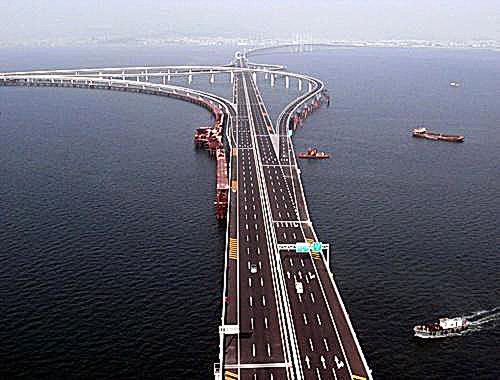
 China’s massive Qingdao Gulf Bridge can easily straddle the English Channel, writes Jan de Beer.
Concrete has played an enormous role in the construction of the world’s longest trans-oceanic bridge, the Qingdao Gulf Bridge, officially opened in China’s Shandong province on June 30, 2011 – the 90th anniversary of the founding of the Communist Party in China.
The 41,58-km bridge crosses Jiaozhou Bay to link China’s eastern port, Qingdao, to an offshore island, Huangdao. Qingdao was the location of the sailing events of the 2008 Beijing Olympic Games.
The sea bridge is the first to include a junction over water, and incorporates two cable-stayed bridges: the Cangkou Channel Bridge and Red Island Channel Bridge.
The actual sea-crossing length of Qingdao Bridge is about 25 km and its concrete deck is 35 m wide. A total of 74 million cubic metres of concrete was used for the construction. This is enough to fill 3 800 Olympic-sized swimming pools and – using the same standard – the contractors managed to fill three such pools every day while building the bridge.
The bridge, at its peak, is 149 m high: roughly the equivalent of a 50-storey building. It has six lanes and the speed limit for the 30 000 vehicles that it can carry daily (for toll payment) is 80 km/hour.
Reported costs of the stupendous achievement vary from US $2,3 billion (claimed by the Chinese government) to $8,8 billion suggested by the London Telegraph.
The one-metre-thick bridge has set several world records. In the first place, it rests on 5 127 concrete piles – the highest number ever employed for a similar structure. The piles were cast in place into holes bored into rocks on the ocean floor by a piling hammer because environmental considerations prevented the use of explosives. The fractured rocks – and other construction waste and sewage – were then immediately removed by a vessel as a further measure to prevent environmental harm to the marine life in Jiaozhou Bay. Qingdao is an important tourist venue for China so environmental protection was a major priority.
A total of 1 258 piling cushion caps were used for the construction of the bridge – another world record – and the contractors, Shandong Hi-Speed Group, for the first time globally, used a special non-bottom-sealing technology for the concrete pouring jackets to prevent the jackets from cracking. Such cracking, caused by variations in stress-deformation by new and old concrete, is a major problem for sea-crossing bridge contractors. Shandong Hi-Speed Group developed a special elastic stress absorption layer to prevent cracking.
 A special ‘low pile cap’ technique was used for the first time in sea-bridge construction. This involved casting of pile caps above water, lowering these to the desired level underwater through precise synchronised operation of hydraulic jacks, and then connecting the caps with the piles deep under the water. The pile caps distribute the load of the bridge over the piles.
There are 3 359 m of expansion joints on the bridge – mostly three- and four-seal joints with a movement capacity of 320 mm.
Climatic conditions posed a major challenge for the bridge designers, China’s Shandong Gausu Group. Planning, exploration, design and bidding for the structure started as far back as 1993 and involved academics, foreign bridge building authorities, and ‘several generations of Chinese bridge experts’ who researched meteorology, hydrology, topography, geology, seismology, ocean navigation, aviation, sea ice, thawing and construction – in fact, every aspect of technology that could affect the bridge construction.
Required, in the first instance, were techniques to cope with the potential destructive elements of the high salt content and winter icing of the sea around Jiaozhou Bay. The salinity level is between 29,4 and 32,6% and the sea in the bay is frozen for around two months every year with up to 50 natural freeze-thaw cycles annually.
Furthermore, 18 geological faults were identified and no fewer than 50 ‘multiple-risk sources’. Then appropriate vehicle speed limits (bearing wind factors in mind) had to be determined; as well as lighting, protective barriers, and future maintenance, to name just a few factors.
And, before construction started four years ago, there were also earthquakes and typhoons to consider in designing a bridge expected to last 100 years and – if necessary – resist the impact of a 300 000-ton vessel crashing into it. The bridge had to handle earthquakes up to a magnitude of 8 on the Richter Scale.
The project’s chief engineer, Shaoxin Peng, comments: “It is difficult to say how many concrete samples we tested to solve the problem of corrosion damage to the concrete but we eventually came up with a sufficiently durable mix. We had to raise the corrosion resistance of the concrete and also ensure that the mix met the standards required for the freezing conditions in the bay.”
The location of the undersea piles also called for the most precise of measurements. Researchers formulated countless formulae, learnt why these would not work, repeated the exercise over and over again, and finally arrived at satisfactory positioning.
Two separate groups of workers were used to build the two ends of the Qingdao Bridge. They were apparently greatly relieved when, last year, the bridge connected properly. An ecstatic engineer commented afterwards: “The computer models and calculations are all very well but you cannot really relax until the two sides are bolted together. Even a few centimetres out would have been a disaster….”
China was not averse to using overseas equipment and material suppliers for the project but it appears that only the strong survive when venturing into the Chinese construction arena. Maurer of Germany, suppliers of 191 expansion joints for the bridge, says: “In China, marathon endurance is expected of all contractors and sub-contractors, mixed with sudden sprint capacities, and then conditions may vary from province to province….”
To provide some more graphic comparisons of the scope of this project, hailed by Forbes magazine as one of the world’s “Top 11 Most Incredible Bridges”, the new bridge is 174 times longer than London’s famous Tower Bridge, and 8 km longer than the Dover-Calais ocean crossing – so it would comfortably straddle the English Channel. The steel used in its construction, 450 000 tons of it, is enough for 65 Eiffel Towers. According to the Guinness World Records, Qingdao is 4 km longer than the previous record holder, Lake Pontchartrain Causeway in Louisiana (which, incidentally, has countered this claim by stating that the American bridge is the longest straight bridge in the world!).
But, impressive as it may be, China will in 2016 open a sea bridge that will eclipse even Qingdao. Construction is underway for a 48,2-km-long bridge that will link Hong Kong to mainland China and the gambling centre of Macau. This structure will cross the open sea for 35,4 km and be able to withstand typhoons of over 200 km/hour.
And are there longer bridges on land? Indeed there are and one – not surprisingly – is in China. The Danyang-Kunshan Grand Bridge is an astonishing 193 km long.
Source: Concrete Trends May 2012 published by The Cement and Concrete Institute
Author: Jan de Beer