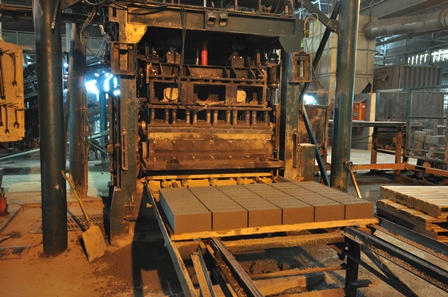
 The rubble that resulted from the implosion last year of Cape Town’s landmark cooling towers at the old Athlone Power Station is being put to good use in the manufacture of concrete masonry and paving blocks.
Cape Brick, a member of the Concrete Manufacturers Association (CMA), has been sourcing up to 75% of its raw material from demolished buildings and other structures with a high percentage of concrete for the past 11 years.
The Athlone cooling towers yielded roughly 16 000m³ of rubble, equivalent to 20 000 tons of concrete, which provided Cape Brick with enough raw material for about four months’ production.Director of the CMA, Hamish Laing, highlights that concrete masonry units produced using recycled concrete have a considerably lower embodied energy than units made using freshly quarried sand and stone aggregates.
Embodied energy, measured in megajoules per kilogram (MJ/kg), is defined as the energy consumed in the manufacture and transportation of construction materials.
Recycled concrete rubble has the same properties as quarried materials so the masonry units offer comparable compressive strengths and the bricks and blocks produced are themselves fully recyclable.
Laing points to a number of direct environmental benefits that derive from recycling rubble for the manufacture of concrete masonry. Fewer virgin aggregates have to be quarried, reducing the environmental impact of sourcing raw materials. There are also reduced transport costs – in terms of energy consumption and emissions – as most quarries are located far from their markets. Construction and demolition rubble is normally dumped, so using it as a raw material source eases the pressure on landfill sites, and most landfill sites are located far from the demolition site, so using these materials locally further reduces transport costs.
Cape Brick also reprocesses its own waste material so it does not have to be dumped, further easing pressure on landfills.
Cape Brick managing director, Anthony Gracie, says it takes about half a megajoule of energy to produce a kilogram of masonry or paving block using recycled material, whereas close on a full megajoule – that is, twice as much energy – is typically required to make the same product using original quarried material.
“In other words, our 190 masonry block, which weighs 16kg, has an embodied energy of 8MJ, whereas a conventional block of the same weight, but manufactured with original materials, has an embodied energy of 15.04MJ. This energy usage can be extrapolated into kilowatt hours (Kw/h) per brick, which in the case of Cape Brick’s 190 block is 2.22Kw/h. The rating for an equivalent conventional block is 4.17Kw/h.”
Gracie says demolition material varies depending on the source and that the challenge is to achieve a material split, grading and shape to provide a consistent aggregate as close as possible to, or better than, original quarried material.
“During the crushing process we aim to achieve a rounded aggregate which yields far better strength and requires less cement than long and flat, or flaky aggregate. We aim for a density of 2 100kg per cubic metre in our brick production. Providing we achieve a nicely cubed aggregate we can achieve this with ease. We have also found that the strength of our blocks shoots up exponentially as soon as the density exceeds 2 100kg/m³.”
Laing adds that a good brick producer should produce no more than 2.5% wastage by mass, including sweepings. “Some brick manufacturers are operating on a basis of 15% wastage which is quite unnecessary if proper processes and quality procedures are followed,” concludes Laing.