Colour Hardener
WHAT IS COLOUR HARDENER?
A granolithic concrete material that is floated into fresh screed or concrete which colours, strengthens and creates durable surfaces for the concrete floors. It is a special blend of cement incorporating very hard-wearing aggregates, lightfast pigments and additives which set rock-hard.
Benefits
- Can be used for interior & exterior floors
- Suitable for domestic or commercial projects
- Colours concrete to a depth of 2-3mm – No risk of colour being rubbed off or abraded
- Extremely durable (but is dependent on screed mix and curing)
- Can be used in conjunction with SuperScreed (10-20mm) where there are height restrictions
- Can be imprinted with patterns




Specifications
| Suitable Surfaces | Interior & exterior concrete or screed base |
| Finish | Steel trowel to a smooth finish Textured, stamped or rolled to obtain different tiled or paved effects |
| Thickness | Depending on screed design – colour penetrates 2-3mm into the screed |
| Application | Sprinkle-on and trowelled |
| Packaging | 20kg bags |
| Coverage | Approximately 5m² per 20kg bag |
| Curing | Leave to air cure for 1 day after completion Damp down with water twice daily for 4 days Allow drying for a minimum of 14 days before sealing |
| Colour/s | Available in 15 colours |
Intended for use with PrimerCote & FlexBond SuperScreed Colour Hardener Sealer Colour Hardener Sealer Slip-Resistant Tools needed Perforated stamper Screed board Wood float or Plastic float Steel trowel Concrete edging tool and/or concrete jointing tool Supporting Cemcrete Products Imprinting mats & Coloured Release Agent (when imprinting) CreteStain CreteCare Mop & Shine CreteCare Polish CreteCare Floor Polish Stripper
Q: Can my builder do the Colour Hardener application? A: If your builder has experience working with Cemcrete products and you feel confident in using them to do the application, then yes. Your builder can also attend our demo days hosted at our Academy in Johannesburg. For more info on these demo days. Cemcrete can also provide you with independent contractor details in your area. Visit our contractors’ website and complete your project details in order for us to assist you with the best contractor for your needs. The independent contractors will provide you with a quote including the product and labour. Q: What type of topping mix should be used with Colour Hardener? A: The preferred ratio of slipperiness is very similar to a porcelain tile. A slip-resistant sealer, which contains our slip-resistant additive, can be used to give your Colour Hardener floor a bit for grip. Furthermore, you can also imprint or texture (by using a sponge roller) your Colour Hardener floor with a texture to reduce the slipperiness. Q: Do you have to seal a Colour Hardener floor? A: Yes. Cement by nature is porous and applying a sealer ensures that your cement floor is protected from any spills or normal wear and tear. Q: Can I power float a floor after Colour Hardener application? A: Yes a Colour Hardener floor of a large area can be power floated. Please contact our technical team for more information on the processor download the datasheet. Q: How long after the Colour Hardener application can you walk on the floor? A: After 24 hours light foot traffic is allowed for curing and sealing purposes only. Q: Can I use underfloor heating with a Colour Hardener floor? A: Various types of underfloor heating can also be used with Colour Hardener floors, for example, you can embed radiant heating cables in cement floors to keep them toasty warm in the winter, or you can use designer installed water heating tubes beneath the screed. One thing that is vital to note, is that in essence cement is not a flexible material, therefore during heating and cooling expansion and contraction takes place and you run the risk of the floor cracking. However, using slow and gradual heating solutions and rather leaving them on for the duration of winter can minimise this risk as the floor is exposed to less erratic temperature variances. Stability is key to reduce the risk. Q: Will my Colour Hardener floor crack and what measures can be taken to minimise the chances of it happening? A: Hairline cracking is normal, by nature cement is not flexible, so movement and temperature variances causing expansion and contraction and shrinkage may cause fine hairline cracks. This is part of the natural element of a cement finish and adds to the unique look and feel. However, the correct preparation and application processes are vital to avoid bigger cracks from appearing. Also adding expansion joints, dividing your cement floor into big blocks, can help to allow for movement and could prevent larger cracks from appearing.
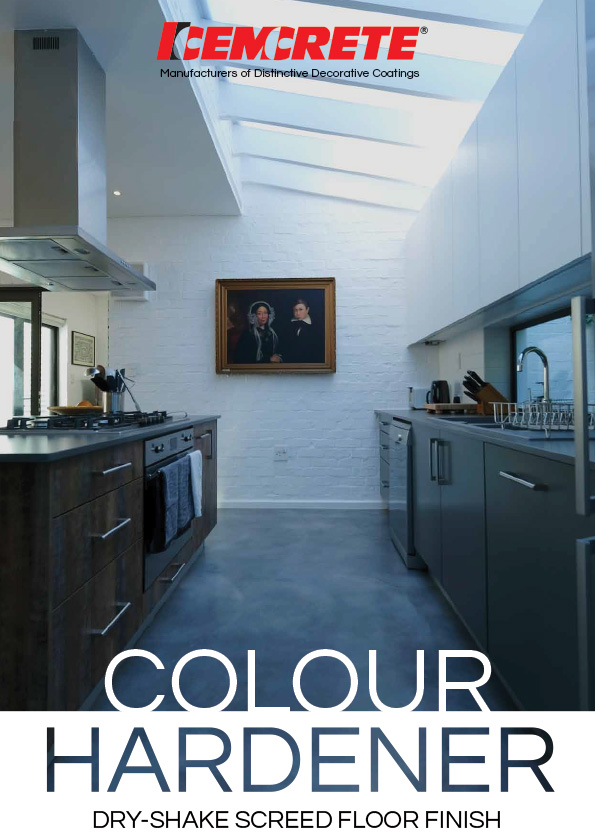
Dry-shake Screed Colour Hardener – A granolithic concrete material that is floated into fresh screed or concrete which colours, strengthens and creates durable surfaces for concrete floors.